

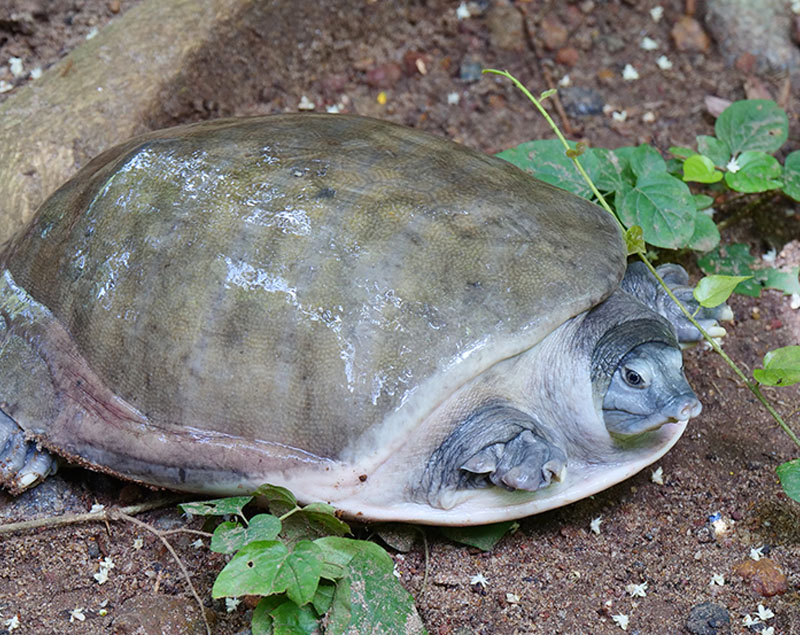
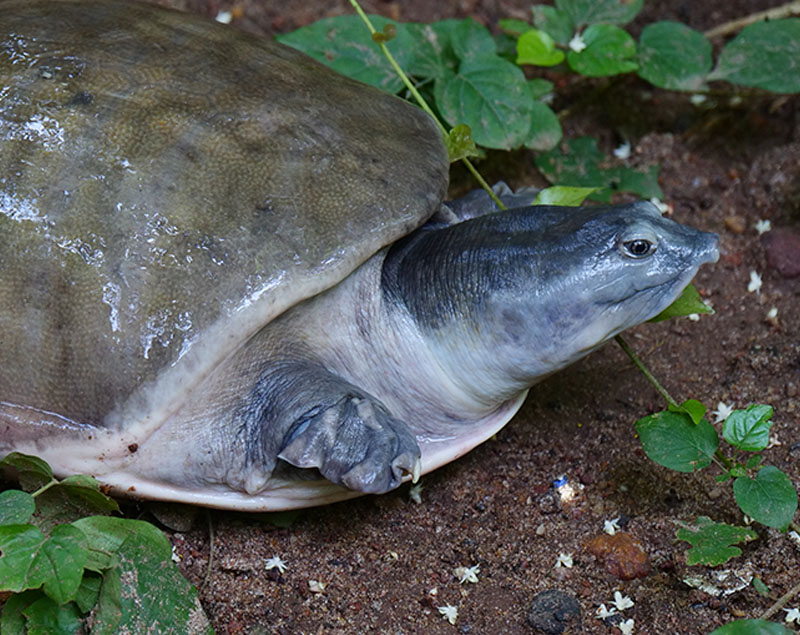
The Indian softshell turtle is identified based on the structure of the carapace and plastron. There are eight pairs of costal plates, the last well developed and in contact throughout on the median line; two neurals between the first pair of costals; plates coarsely pitted and vermiculate.
The Indian softshell turtle, or Ganges softshell turtle is a species of softshell turtle found in South Asia in rivers such as the Ganges, Indus and Mahanadi. This vulnerable turtle reaches a carapace length of up to 94 cm. The Indian softshell turtle is olive above; the back of the young is vermiculated with fine black lines, but without ocelli; the head with a black longitudinal streak from between the eyes to the nape, intersected by two or three inverted-V-shaped black streaks; lower parts are yellowish

Nilssonia gangetica

Nilssonia

20-40+ years

Indian softshell turtles are adapted to the aquatic lifestyle and spend most of their time in the water. During sunny days they often come out of the water to bask on sand. During the dry season, Indian softshell turtles may burrow into the mud to aestivate in order to conserve energy and survive during the heat. These turtles usually spend their time singly but may gather in small groups when basking or in areas where food is abundant.

Trionychidae

50KG

These softshell turtles are found in the Indus, Ganges/Padma, Meghna, Brahmaputra, Jamuna, Narmada and Mahanadi basins and most of their tributaries and intervening drainages and in the countries of Afghanistan, Bangladesh, India (Assam, Bihar, Gujarat, Jammu & Kashmir, Madhya Pradesh, Orissa, Punjab, Rajasthan, Uttar Pradesh and West Bengal), Southern Nepal and Pakistan.

They mainly eat fish, amphibians, carrion, and other animal matter, and will supplement their diet with aquatic plants